The Ministry of Health encourages smokers to adopt vaping as a method to quit, despite the number of deaths and unknown illnesses it has been linked to.
Zeelan
Talagi with more.
“The
Ministry of health launched a website in August, promoting vaping as a healthy
alternative to smoking, as a part the Smokefree 2025 campaign. Since then, the
US has reported 530 cases of vape related illnesses, 1 resulting in death.
Despite this new information, the Ministry of health has yet to update their “Position on vaping” they posted in September last year, This is Zeelan Talagi”
Sports TP
A young Kiwi athlete hasn’t received any financial support, despite her exceeding SportNZ eligibility criteria.
SportNZ communication manager, Phillip Clark said typically an athlete competing for two nations would qualify for funding, however each sport has their own governing body.
16-year-old cheerleader, Anna
Grigson, has represented 3 countries internationally, without any funding from The
New Zealand Cheerleading association.
Anna’s mum, Becky Grigson said the
lack of support for high performing cheerleaders is frustrating and says
waiting until cheerleading becomes an Olympic sport is too late.
NewtalkZB has attempted to contact
New Zealand’s governing body for Cheerleading: NZCA. However they failed to
comment on funding for individual athletes.
On Saturday the 3rd of August (TX, USA), 22
people were shot dead in an El Paso Walmart, located on the border of Mexico
and the US. 1news first reported the shootings in an article published on their
website, which detailed the known information regarding when and where the
shootings took place, accompanied by crowd sourced images and video, this
article was then posted to Facebook at 8.21 am. 1news made similar posts on
Twitter backlinking the articles to their website. The 1news coverage continued
across traditional TV coverage, with the El Paso shootings leading the 12pm,
6pm and 10pm bulletins on the 4th and 5th of August, all
of which were made available on TVNZ on demand.
The tragedy of the El Paso shootings is deemed newsworthy
as the events were “generally considered to be unpleasant or harmful.”
(Haskins,1981, pg.5), categorizing the event as bad news, Harcup and O’neill
(2016) claim is one of the most popular determinants of news. Audiences need to
know of ‘bad news’ events such as the El Paso shootings as they affect a lot of
people and expose potentially greater political issues regarding gun safety.
TVNZ state on their website, they value producing information that New
Zealanders care about, this news is of interest to New Zealanders as it is
reminiscent of the Christchurch mosque attacks that occurred in earlier this
year.
Traditional TV
broadcast
Breaking news delivered across traditional Television broadcast, remains the most popular source of news, 1news has 3 appointment viewing of the news everyday: 12pm, 6pm, 10pm reaching an average of 82% of New Zealand households weekly (NZ On Air & Glasshouse consulting, 2018). This statistic was dominated by people over the age of 45, these findings are suggestive of an intergenerational technology gap. On August the 5th, 6pm 1news bulletin was led by the El Paso shootings and its connection to the Christchurch mosque shootings. The traditional TV broadcast format means that information is only delivered to the audience once, the use of clear visuals (fig 1), concise and conversational language enabled effective communication to an audience of an ‘ordinary person’ (Bernas & White, 2013). The broadcast then crossed to a package from a US correspondent whereby live witness footage was used alongside commentary providing more information and context around the shootings. The use of such raw footage was likely to make the audience feel emotional in some way as it adds a sense of realism to the story.
Fig 1. Screenshot from the 5th of August live TV Broadcast of a clear map that illustrated where the shootings took place, where they were in relation to Mexico and the distance the gunman had to travel to carry out the shooting.
TVNZ On
Demand
Once the new has been broadcast live on TV, it
is uploaded to TVNZ on demand where each day’s recording is
available to view for up for up to 6 days from the time it has been uploaded.
The weekly audience of TVNZ OnDemand had increased by 15.2% in a year from
2017, reaching 102 million online streams in 2018, of which 26% of that
audience is comprised of 18 – 24-year old’s (TVNZ, 2018a & b). This
positive trend reflects the medium’s ability to provide content not strictly
bound by time, and the audience’s desire for choice and flexibility while still
being able to enjoy the traditional format of TV news. The content is the same
as what is broadcasted live on TV; however, it is not restricted by it’s ‘liveness’,
audiences are able to re-watch it and rewind as they please.
1news website
1news reuses the important information from these broadcasts reproduces it in a written format as online content for 1newsnow. On the 1news website, the story of the El Paso shootings was developed and told from multiple angles. In the week covering the El Paso shootings, 1news produced 10 articles many of them focusing of the US reaction to the tragedy. The proceeding articles typically fell into two categories: Human interest stories of those who either died or survived, or Donald Trump’s response and his ‘next steps’ to ensure change. The audience for this online content is skewed towards younger people aged 18 – 24 as they have greater accessibility personal devices to view the content on (NZ On Air, 2018). The online news content was presented multimedia format, using tweets, crowd-sourced raw footage and images all to help communicate the tragedy and it’s affects (fig 2). This has been seen as journalism’s next steps in the industry, diversifying content approach, Bruns, A. (2017) says the role of citizens has been instrumental in the “construction of event driven news” (pg. 70).
Fig. 2 Article posted to the 1news website; video shows the various multi-media elements used to communicate the first reports of the El Paso shootings.
Facebook
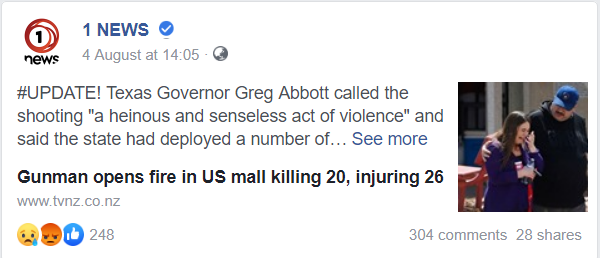
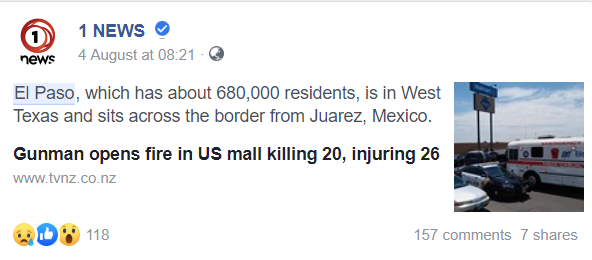
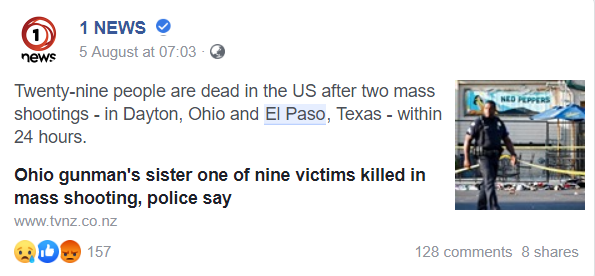
Facebook is one of the social platforms used by 1news now to redistribute the information to reach a different audience. Fig. 3 shows 1news used the same article in these two different Facebook posts, the only difference being, the information used to caption the article. Research has shown that Facebook has become a more popular source of news than the newspaper, this was a tactically way to drive Facebook traffic to their website (NZ On Air, 2018)
Fig 3. Shows the side by side comparison of two 1news Facebook posts that backlinked to the same article on their website.
Twitter
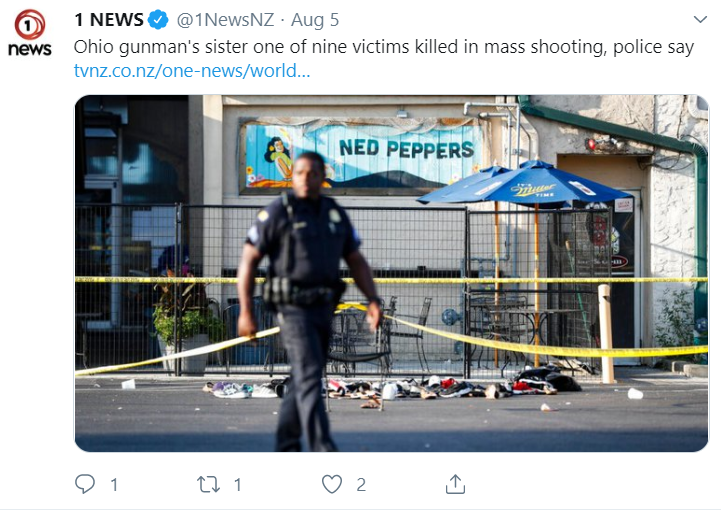
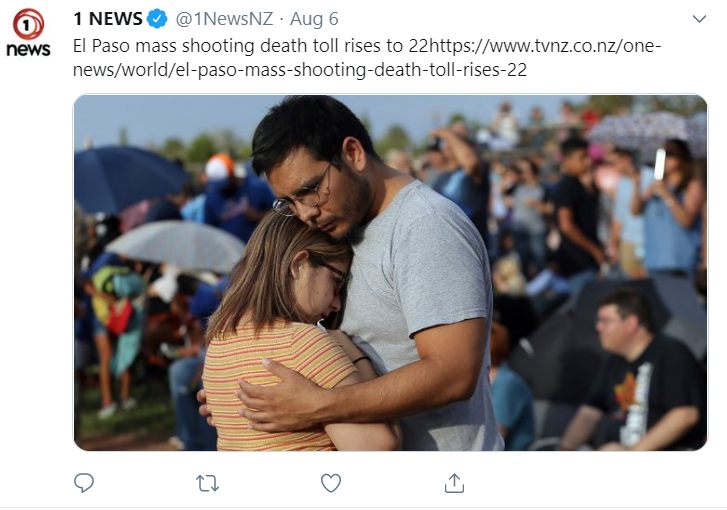
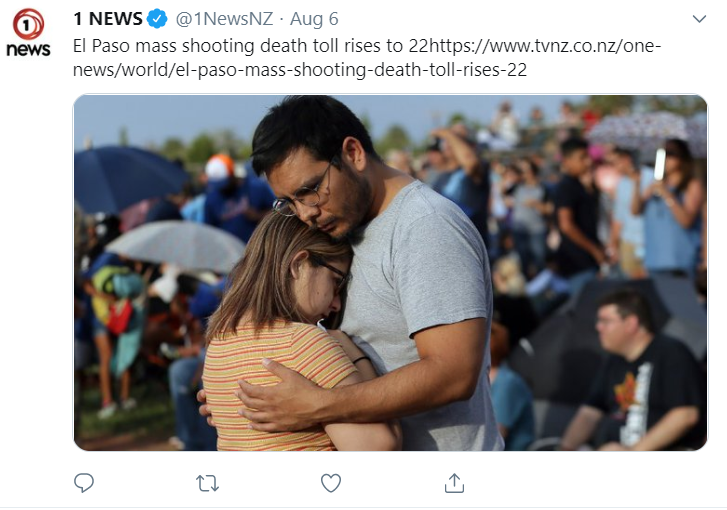
Twitter has become a significant source in the news cycle all over the world, its ability to serve information instantaneously is increasing the pace and pressure on traditional news systems, provoking questions regarding the future of journalism (Hermida, 2010). NZ On Air (2018) found that students who possessed devices that connected to the internet and were therefore more likely to use social media to access news information, studies have also found that Twitter users are more likely to engage in with news content (Phillips, 2012). However, there was very little engagement if any to the 1news tweets regarding the El Paso shooting as shown in fig.4. This could be because the platforms appeal is it’s fast paced sharing of information and those who follow 1news on Twitter could possibly have seen the same information on a different platform, this is likely as there is a young people make up a significant portion of the audience across all 1news platforms.
Fig 4. Shows very little to no engagement with these El Paso shooting tweets shared by 1news.
In a study conducted by Phillips (2012) found, that although ‘hard news’ can be posted to Twitter, Facebook generates greater traffic. The figure below shows the same post 1news Twitter posts almost the same as it’s Facebook posts, however a noticeable difference is the lower levels of engagement, in the same post made to Facebook and Twitter. Again, this could have been because audiences had seen the content on Facebook first.
Fig. 5 comparison of Facebook (left) and Twitter (right) posts and their level of engagement.
References
Bruns, A. (2018). Gatewatching and news curation: Journalism, social media, and the
public
sphere. New York, NY: Die Deutsche Nationalbibliothek.
Harcup, T., & O’neill, D. (2017).
What is news? News values revisited (again). Journalism
studies, 18(12), 1470-1488.
Haskins, J. B. (1981). The trouble with
bad news. Newspaper Research Journal,
2(2), 3-16.
Hermida, A. (2010).
Twittering the news: The emergence of ambient journalism. Journalism
practice, 4(3), 297-308.
NZ On Air (2018). Where are the audiences? 2018 – Full report
On the 13th of January, a Christchurch triple-fatality crash claimed the lives of two 13-year-old boys, Craig Mcallister and Brooke Taylor and 16 year – old, Glen Mcallister. Prior to the crash, the stolen vehicle the boys had been travelling in was seen driving up to 130 km through central Christchurch. Police began to pursue the car, but aborted the pursuit in the best interests of the public and those in the car, instead they laid spikes which the speeding car hit, causing it to spin of control out and hit a tree. The media coverage of the crash, evolved from questions of how and why the crash occurred to, a focus being placed on the criminal past of the Mcallister brother’s family.
Police Media Team (2019) reported the first information about the crash on the 14th of January, in a written statement published to their website. Later that day, they held a press conference whereby they stated the details of the crash and expressed sympathy for the victims and of the crash and their families. The New Zealand media took to social media to source information about who the victims of the crash were, as the police did not officially announce the names of the victims until the 22nd of January, 9 days after the crash occurred. News agencies have various ways of sourcing information, death certificates, tributes written to victims online, interviewing police of offices at times court documents can also be used (Victims Information, 2016). The competition values of privacy and public interest are often raised in discussion of the limits regarding journalism, however Tverdek (2008) states “By choosing to act in a space to which others have a ready access, one surrenders one’s claims to privacy with respect to a potential audience”. Social media played a large role in the journalists gathering of information and photos to accompany their stories. Many of the photo’s used of the teenagers in the articles about the crash, were sourced from the Facebook pages of the victims or their families as noted by the credits under the photos used. Facebook tributes posted by the victims’ families and friends also heavily featured in the coverage of the crash. Newshub reported the Mcallister brother’s mother, Juanita Hickey posted on her now private “My beautiful baby boys… Sadly life dishes me incredible hurt like no other”.
Morse (2014) says the difficulty lies in striking the balance between “human dignity” and “the public’s right to know”. Both of these factors hold their own significance.
TVNZ Article containing a video of Superintendent, John Price talking to the media about the crash and the officers decision to pursue the vehicle and abort the pursuit.
This crash was of particular public interest as it was the third fatal police pursuit in Christchurch within a period of two months. Hamad (2017) argues that serving the public interest is the media’s most “essential function”, as the media can serve as a watchdog by holding the government accountable for their responsibility to keep citizens safe. Much of the initial media coverage focused on the interrogating the police regarding their fleeing driver’s pursuit policy, Superintendent John Price addressed this in the media conference whereby he outlined the details of the pursuit. The Mazda Familia the teenagers had stolen earlier that night was travelling at speeds up to 130 km, the police pursued the vehicle for under a minute, then abandoned the pursuit and entered into an enquiry phase. The decision to abort the pursuit was reported on by Newshub, Stuff and NZ Herald, questions were posed as to why the police undertook those actions. John Price said “Police always face a difficult challenge of balancing, protecting the public from dangerous driving behaviour and potentially causing the offending driver to take greater risks”. Whereby he acknowledged to the wider contextual issue of the frequency of fatal police pursuits the media had highlighted in articles like “The faces of fatal police chases: Teens make up half of crash victims” (Macmanus, 2019) which collated 27 police pursuit fatalities since 2015, where 13 of them were teenagers.
RNZ reported the findings of the investigation released in March this year, The IPCA chairperson Judge Colin Doherty said that there would be no direct changes to the police pursuit policy but rather the approach and training of the officers would change, prompting more “risk-averse” mindset strategy, allowing the pursuit policy to be exercised effectively. However, as RNZ later reported in April, additional pressure the Children’s commission resulted in the police consideration of trailing a revised policy for a 12-month period to not pursue young drivers. The topical nature of police pursuits saw the NZ Herald, launch an online series of articles called: The Chase; looking into the IPCA recommendations for the police and the experiences of those involved in police pursuits.
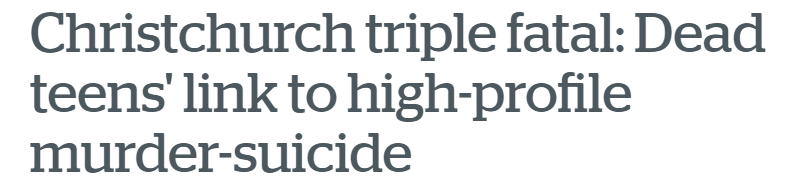
On the 17th of June the Herald broke the news, of the criminal past of the Mcallister brother’s family in a headline that read:
Headline of the first article about the Christchurch crash that referenced the criminal history of the uncle and father of the Mcallister brothers.
This article revealed, Glenn Mcallister the uncle of Glenn and Craig Mcallister who died in the car crash, was the gunman who shot and killed a 22 year- old then proceeding to himself in the Christchurch city centre 1989. The 22 year- old victim was later revealed to be Wayne Motz, the son of “cricketing great” Dick Motz as reported by Stuff (2019) . The New Zealand media were quick to pick up this angle and from that point onwards used the Mcallister criminal uncle to frame the news about the crash. NZ
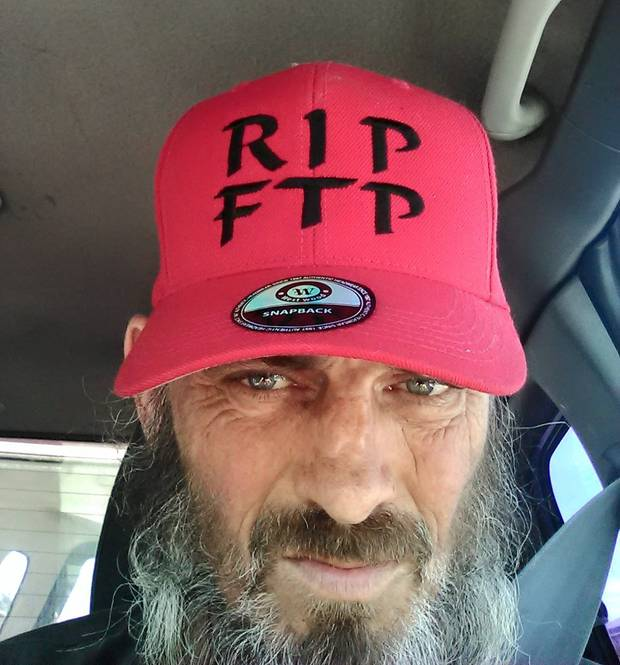
These articles also made reference to the past of the Mcallister brother’s father, Craig Mcallister. The portrayal of Craig as a grieving was distorted by the reports of him being an ex-drug addict and former skinhead. Craig spoke to the NZ Herald pleading with the public not to judge him and his family, whereby he made the accusation: “the police killed my kids… it’s not about me”. NZ Herald then reported Craig had posted a picture to his Facebook account sported a red cap embroided with the names of deceased children Glen and Craig and ‘RIP FTP’ on the front. While the New Zealand media, reported on Juanita Hickey’s Facebook tributes with headlines such as: “Grieving mother of brother killed in Christchurch police chase is in severe shock”. Whereas reports of the tributes posted by Craig Mcallister were treated with a “controversy frame” (D’Angelo, P., & Kuypers, J. A., 2010) of which Entman (1993) says “ will guide the audience members’ feelings and thoughts about the controversy in predictable ways”.
Photo Craig Mcallister posted, showing his customized hat paying tribute to the death of his two sons : Glenn and Craig Mcallister.
The use of the journalistic ‘controversy frame’ was clearly demonstrated by Andrew Dickens who wrote an opinion piece by Andrew Dickens titled: “To the dad of the Mcallister boys who died in the Christchurch crash: You’re wrong it’s about you”, heavily criticizing Craig Mcallister’s demeanor. Dickens was quoted to have said it was a case of the “feral bringing up the feral, trash begets trash”, he critized Craig for his dismissal of his son’s stealing crashes before their death and his “boys will be boys comments”. Dickens comments were largely popular with the public, and garnered many, shares, likes and comments. Excerpts from Dickens opinion was later quoted in articles by the NZ Herald and Newshub.
“Journalists are compelled to report the news, not create the news” (Applegate, 2007) of which The Spinoff’s, Madeline Chaplin argued, the later was demonstrated in the reporting of the Mcallister boy’s death. In an opinion piece that served as a rebuttal to the reporting of Dickens opinion piece, Chaplin spoke about the disservice New Zealand media had done by vilifying the dead teenagers because their blood relation to Glen Mcallister and to their ex-skinhead father. Chaplin, heavily criticized news sources such as the NZ Herald for their story: “Dead teen’s link to high-profile murder-suicide”, whereby she questioned whether those articles were constructed objectively, reinforcing the view perpetuated by Applegate (2007) “Reporter sometimes push their ideas in stories”. Simpson and Cote (2006) said “Reporters should avoid speculating about what caused someone’s death”. As this story developed, it became less about what happened and rather about who was to blame, firstly the public and the media placed the attention on the police, secondly Dickens had placed blame on Craig Mcallister.
RNZ interview with Juanita Hickey where she alleges the DHB’s dismissive care of her son Craig was a contributing factor to his death.
The media discussion in regard to who was to blame for the crash resurfaced in early May, as the Mcallister boy’s mother Juanita Hickey spoke to RNZ, where she alleged that the DHBs negligence in refusing to provide care for her 13-year-old boy Craig Mcallister contributed to his death. In article produced by 1newsnow, Juanita spoke openly about have a premonition that her son was “going to die”. The reports done on Juanita Hickey and her perspective, contrast significantly with the articles produced comments made by the father, Craig Mcallister. In Hickey’s interviews she was depicted as a grieving mother who had grievous concerns about her sons before their death,
Craig Mcallister comments blaming the police; however, he was not depicted in the same empathetic light. Firstly, emotive language was used to describe Juanita; she was said to have “begged”, “pleaded”, “extreme fears” as written by RNZ, 1newsnow, Stuff, all of which depicted her as a person grieving for the loss of her son. Whereas the media became fixated on the Craig Mcallister’s criminal past, once that information was released that became the description of the father: “former drug addict” and “ex- skinhead”. The differences in the reporting of the demonstrated the journalist’s construction of news, framing articles glorifying the perspective of Juanita Hickey and vilifying Craig Mcallister.
References
1newsnow (2019) Christchurch mother whose teen sons died after speeding from police: ‘I had extreme fears that Craig was gonnadie’
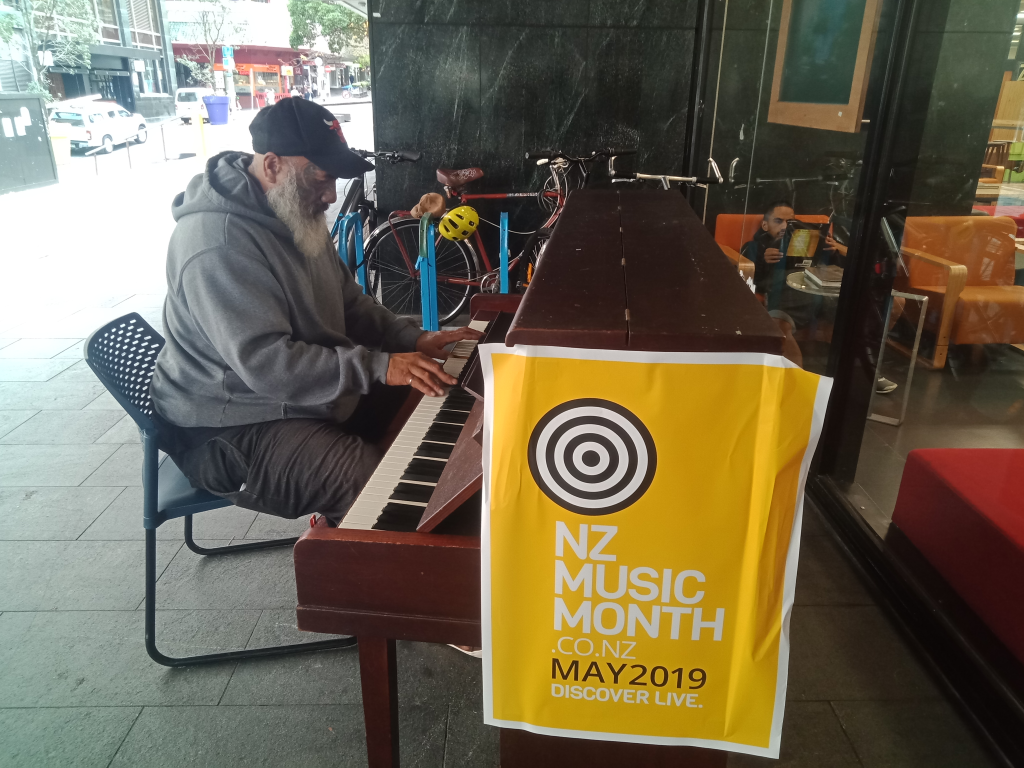
Homeless man, Cookie playing the songs he has memorized from YouTube Tutorials. Credit: Zeelan Talagi
After a year of
watching YouTube tutorials, 55-year-old, Cookie, is delighted to be able to
play on a public piano.
The piano stands
outside the Auckland City library on Lorne street, and placed there every May,
as the library’s traditional celebration of New Zealand Music Month.
When Cookie first
started, he said he was “robot-like” and only knew the “Chopsticks”. One year
on, Cookie can play a variety of songs from John Legend to Elton John.
The Auckland man
said he wasn’t concerned about learning to read music, “I’ll be 155 years old
if I learnt that way”. He started with the desire to learn just one song from
the start to finish, now he wants to learn how to play every tune he enjoys.
Librarian
assistant, who helped organize this year’s piano display, Dedee Wirjapranata
said the public piano supports the message that “music is for everyone, anyone
can come, play and enjoy it”.
Cookie said, “I
find playing music is therapeutic for me”, he really enjoys playing the piano
outside the library because often the people walking by pay him compliments and
give him tips to help him improve. Both of which inspire him to play more.
Rodney Fisher, a
representative of New Zealand Music Month, praised the Auckland City Library
for the public piano, saying “it’s really cool to make having an instrument
accessible to anyone and everyone”.
Ideally, Rodney
said, “there would be pianos on every street corner” and community music
initiatives like this are “amazing” and “should be encouraged”.
The piano has
drawn people of all musical abilities, from people who can play advanced
classical pieces to children just “clanking” on the keys, said Dedee. All of
which can be heard all throughout the library opening hours and from the other
end of the building.
The library has an
electric keyboard inside, but as Dedee said it doesn’t compare, “Having a piano
just sitting here, people can practice what they’ve heard or just have the
pleasure of playing a piano and hearing that sound.”
Interview with Auckland City Librarian Assistant, Dedee Wirjapranata , with exerts of piano playing by Cookie. Credit: Zeelan Talagi
70-year-old pole dancer to take on the best of the best to compete for the title of Ultimate Pole Legend 2020.
Next year, Glynn Owens hopes to mark his 70th
birthday milestone by being selected to compete in the prestigious Ultimate
Pole Legends event.
Glynn starting pole dancing at the age of 63, after watching
a legends competition and being in awe of the performers. Six years on, Glynn
trains up to three times a week, each session at least an hour if not two hours
long.
The Glendowie retiree is currently preparing for the New
Zealand Amateur Pole championship, where he will perform in the Auckland heats
of the competition in May. This of course all in the pursuit of his greater
goal to compete in Pole Legends.
The Pole Legends competition is the largest pole competition
in New Zealand. This competition is only for the most elite pole dancers, to
compete you must pass the vigorous selection process.
Applicants submit a video that is judged by international
judges, the top 20 performers are chosen to compete in the live rounds, where
the performer with the highest average rank wins the title of Ultimate Pole
Legend.
Glynn was selected last year as one of the top 5 Male pole
dancing performers in New Zealand to compete at the Pole Legends competition
and according to Kerry Summers, organizer of the event “the oldest competitor
to do so”.
As of this year, that selection process has changed,
potentially making it harder for Glynn to achieve his 70th birthday
goal. Judges will now choose the 20 most talented Pole performers in New
Zealand, regardless of their category.
Kerry said “changes were made because a lot of talented
female ‘polers’ missed out” while other athletes automatically got in because there
were fewer people in their category.
The owner of Limitless pole studios, Natasha Patel said “it
is extremely hard to be admitting into the competition, it is even harder to
progress through to the final”.
Natasha competed in the Legends competition a few years ago
in a duo and says with the recent changes made, “you truly have to be the crème
of the crop to be chosen”.
Glynn, not driven by a competitive spirit is just excited
for the opportunity to compete against New Zealand top pole performers.
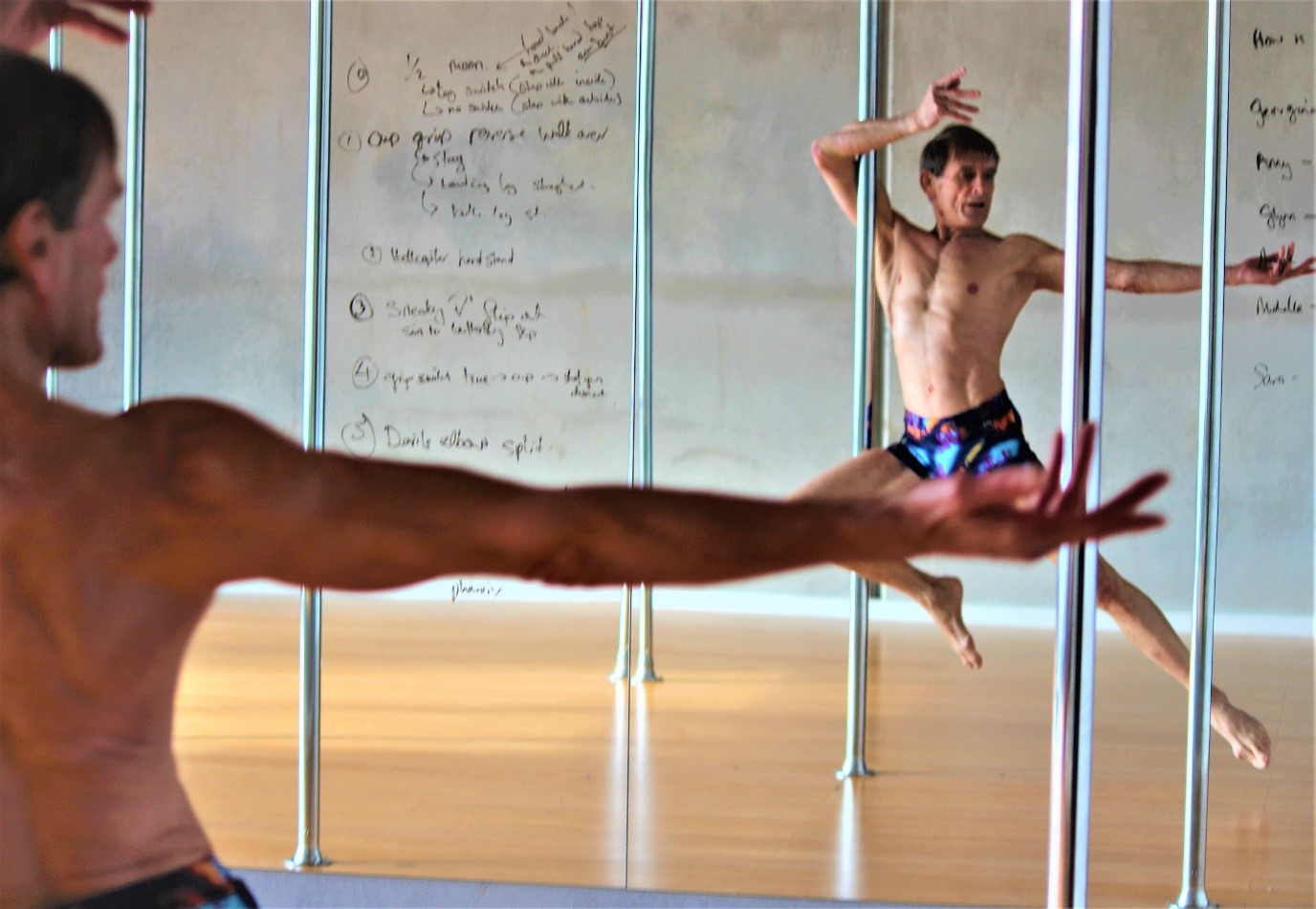
Glynn
Owen, 69, working hard to perfect his tricks for the Pole Legends competition.


 Journalism blog