On Saturday the 3rd of August (TX, USA), 22 people were shot dead in an El Paso Walmart, located on the border of Mexico and the US. 1news first reported the shootings in an article published on their website, which detailed the known information regarding when and where the shootings took place, accompanied by crowd sourced images and video, this article was then posted to Facebook at 8.21 am. 1news made similar posts on Twitter backlinking the articles to their website. The 1news coverage continued across traditional TV coverage, with the El Paso shootings leading the 12pm, 6pm and 10pm bulletins on the 4th and 5th of August, all of which were made available on TVNZ on demand.
The tragedy of the El Paso shootings is deemed newsworthy as the events were “generally considered to be unpleasant or harmful.” (Haskins,1981, pg.5), categorizing the event as bad news, Harcup and O’neill (2016) claim is one of the most popular determinants of news. Audiences need to know of ‘bad news’ events such as the El Paso shootings as they affect a lot of people and expose potentially greater political issues regarding gun safety. TVNZ state on their website, they value producing information that New Zealanders care about, this news is of interest to New Zealanders as it is reminiscent of the Christchurch mosque attacks that occurred in earlier this year.
Traditional TV broadcast
Breaking news delivered across traditional Television broadcast, remains the most popular source of news, 1news has 3 appointment viewing of the news everyday: 12pm, 6pm, 10pm reaching an average of 82% of New Zealand households weekly (NZ On Air & Glasshouse consulting, 2018). This statistic was dominated by people over the age of 45, these findings are suggestive of an intergenerational technology gap. On August the 5th, 6pm 1news bulletin was led by the El Paso shootings and its connection to the Christchurch mosque shootings. The traditional TV broadcast format means that information is only delivered to the audience once, the use of clear visuals (fig 1), concise and conversational language enabled effective communication to an audience of an ‘ordinary person’ (Bernas & White, 2013). The broadcast then crossed to a package from a US correspondent whereby live witness footage was used alongside commentary providing more information and context around the shootings. The use of such raw footage was likely to make the audience feel emotional in some way as it adds a sense of realism to the story.

Fig 1. Screenshot from the 5th of August live TV Broadcast of a clear map that illustrated where the shootings took place, where they were in relation to Mexico and the distance the gunman had to travel to carry out the shooting.
TVNZ On Demand
Once the new has been broadcast live on TV, it is uploaded to TVNZ on demand where each day’s recording is available to view for up for up to 6 days from the time it has been uploaded. The weekly audience of TVNZ OnDemand had increased by 15.2% in a year from 2017, reaching 102 million online streams in 2018, of which 26% of that audience is comprised of 18 – 24-year old’s (TVNZ, 2018a & b). This positive trend reflects the medium’s ability to provide content not strictly bound by time, and the audience’s desire for choice and flexibility while still being able to enjoy the traditional format of TV news. The content is the same as what is broadcasted live on TV; however, it is not restricted by it’s ‘liveness’, audiences are able to re-watch it and rewind as they please.
1news website
1news reuses the important information from these broadcasts reproduces it in a written format as online content for 1newsnow. On the 1news website, the story of the El Paso shootings was developed and told from multiple angles. In the week covering the El Paso shootings, 1news produced 10 articles many of them focusing of the US reaction to the tragedy. The proceeding articles typically fell into two categories: Human interest stories of those who either died or survived, or Donald Trump’s response and his ‘next steps’ to ensure change. The audience for this online content is skewed towards younger people aged 18 – 24 as they have greater accessibility personal devices to view the content on (NZ On Air, 2018). The online news content was presented multimedia format, using tweets, crowd-sourced raw footage and images all to help communicate the tragedy and it’s affects (fig 2). This has been seen as journalism’s next steps in the industry, diversifying content approach, Bruns, A. (2017) says the role of citizens has been instrumental in the “construction of event driven news” (pg. 70).
Fig. 2 Article posted to the 1news website; video shows the various multi-media elements used to communicate the first reports of the El Paso shootings.
Facebook is one of the social platforms used by 1news now to redistribute the information to reach a different audience. Fig. 3 shows 1news used the same article in these two different Facebook posts, the only difference being, the information used to caption the article. Research has shown that Facebook has become a more popular source of news than the newspaper, this was a tactically way to drive Facebook traffic to their website (NZ On Air, 2018)
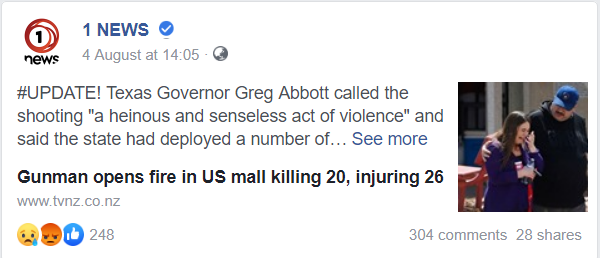
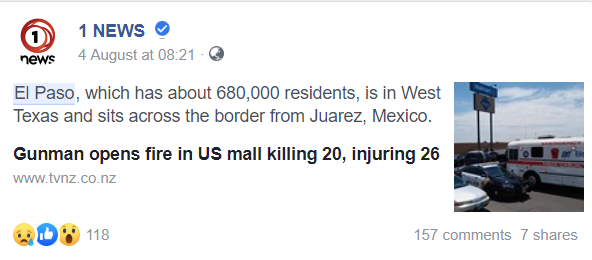
Fig 3. Shows the side by side comparison of two 1news Facebook posts that backlinked to the same article on their website.
Twitter has become a significant source in the news cycle all over the world, its ability to serve information instantaneously is increasing the pace and pressure on traditional news systems, provoking questions regarding the future of journalism (Hermida, 2010). NZ On Air (2018) found that students who possessed devices that connected to the internet and were therefore more likely to use social media to access news information, studies have also found that Twitter users are more likely to engage in with news content (Phillips, 2012). However, there was very little engagement if any to the 1news tweets regarding the El Paso shooting as shown in fig.4. This could be because the platforms appeal is it’s fast paced sharing of information and those who follow 1news on Twitter could possibly have seen the same information on a different platform, this is likely as there is a young people make up a significant portion of the audience across all 1news platforms.
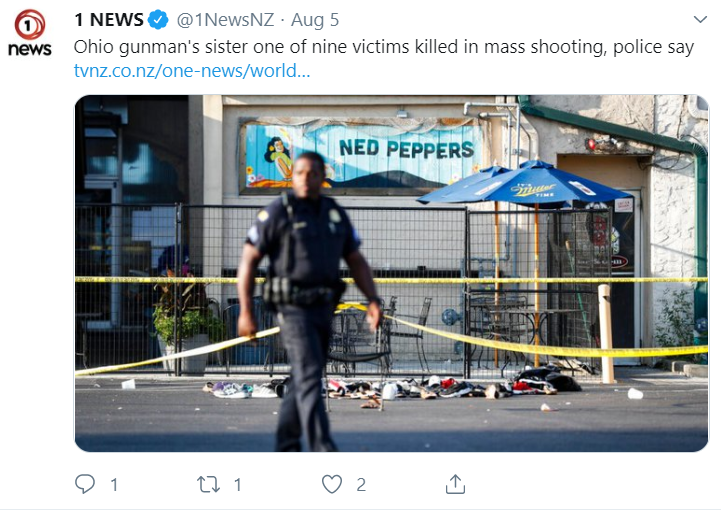
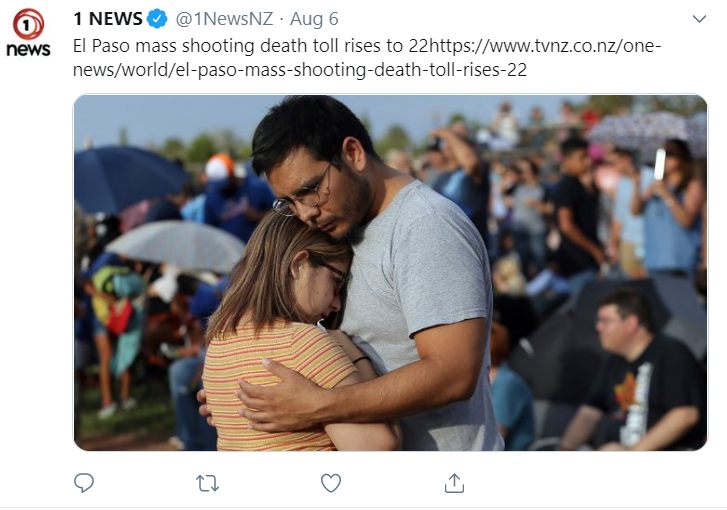
Fig 4. Shows very little to no engagement with these El Paso shooting tweets shared by 1news.
In a study conducted by Phillips (2012) found, that although ‘hard news’ can be posted to Twitter, Facebook generates greater traffic. The figure below shows the same post 1news Twitter posts almost the same as it’s Facebook posts, however a noticeable difference is the lower levels of engagement, in the same post made to Facebook and Twitter. Again, this could have been because audiences had seen the content on Facebook first.
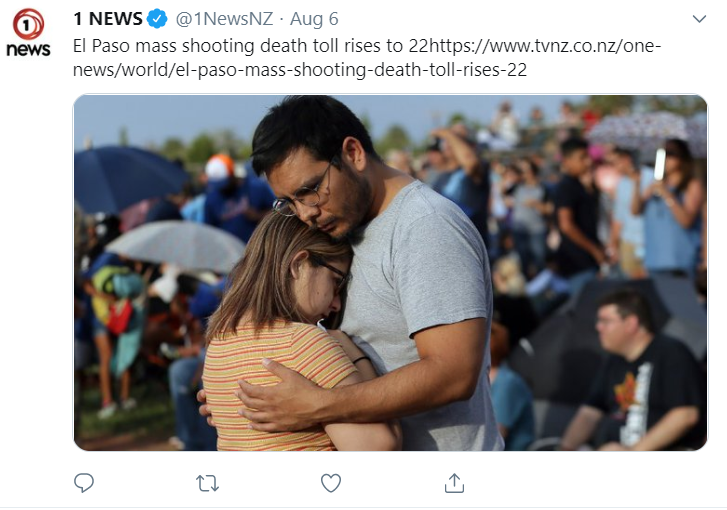
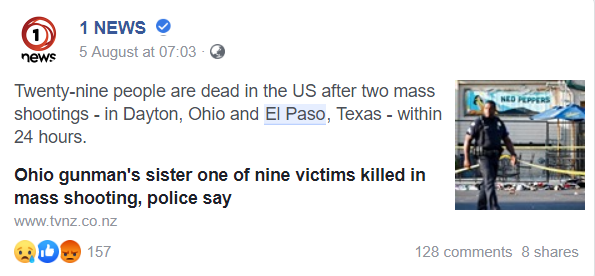
Fig. 5 comparison of Facebook (left) and Twitter (right) posts and their level of engagement.
References
Bruns, A. (2018). Gatewatching and news curation: Journalism, social media, and the public
sphere. New York, NY: Die Deutsche Nationalbibliothek.
Harcup, T., & O’neill, D. (2017). What is news? News values revisited (again). Journalism
studies, 18(12), 1470-1488.
Haskins, J. B. (1981). The trouble with bad news. Newspaper Research Journal, 2(2), 3-16.
Hermida, A. (2010). Twittering the news: The emergence of ambient journalism. Journalism
practice, 4(3), 297-308.
NZ On Air (2018). Where are the audiences? 2018 – Full report
Retrieved from: https://www.nzonair.govt.nz/research/where-are-audiences-2018- Reaching%20the%20Unreachables.pdftargeted-audiences-report/
Phillips, A. (2012) Sociability, Speed and Quality in the Changing News Environment.
Journalism Practice 6(5), 669–679.
TVNZ (2018a). Reaching the unreachables Boost your youth audience with TVNZ on demand.
Retrieved from: https://www.tvnz.co.nz/content/dam/images/tvnz-sales/Insights/
TVNZ (2018b). TVNZ lifts earnings & cracks 100 million streams
Retrieved from: http://tvnz.co.nz/tvnz-corporate-comms/lifts-earnings-cracks-100-million-streams-6574493

 Journalism blog