On the 13th of January, a Christchurch triple-fatality crash claimed the lives of two 13-year-old boys, Craig Mcallister and Brooke Taylor and 16 year – old, Glen Mcallister. Prior to the crash, the stolen vehicle the boys had been travelling in was seen driving up to 130 km through central Christchurch. Police began to pursue the car, but aborted the pursuit in the best interests of the public and those in the car, instead they laid spikes which the speeding car hit, causing it to spin of control out and hit a tree. The media coverage of the crash, evolved from questions of how and why the crash occurred to, a focus being placed on the criminal past of the Mcallister brother’s family.
Police Media Team (2019) reported the first information about the crash on the 14th of January, in a written statement published to their website. Later that day, they held a press conference whereby they stated the details of the crash and expressed sympathy for the victims and of the crash and their families. The New Zealand media took to social media to source information about who the victims of the crash were, as the police did not officially announce the names of the victims until the 22nd of January, 9 days after the crash occurred. News agencies have various ways of sourcing information, death certificates, tributes written to victims online, interviewing police of offices at times court documents can also be used (Victims Information, 2016). The competition values of privacy and public interest are often raised in discussion of the limits regarding journalism, however Tverdek (2008) states “By choosing to act in a space to which others have a ready access, one surrenders one’s claims to privacy with respect to a potential audience”. Social media played a large role in the journalists gathering of information and photos to accompany their stories. Many of the photo’s used of the teenagers in the articles about the crash, were sourced from the Facebook pages of the victims or their families as noted by the credits under the photos used. Facebook tributes posted by the victims’ families and friends also heavily featured in the coverage of the crash. Newshub reported the Mcallister brother’s mother, Juanita Hickey posted on her now private “My beautiful baby boys… Sadly life dishes me incredible hurt like no other”.
Morse (2014) says the difficulty lies in striking the balance between “human dignity” and “the public’s right to know”. Both of these factors hold their own significance.
TVNZ Article containing a video of Superintendent, John Price talking to the media about the crash and the officers decision to pursue the vehicle and abort the pursuit.
This crash was of particular public interest as it was the third fatal police pursuit in Christchurch within a period of two months. Hamad (2017) argues that serving the public interest is the media’s most “essential function”, as the media can serve as a watchdog by holding the government accountable for their responsibility to keep citizens safe. Much of the initial media coverage focused on the interrogating the police regarding their fleeing driver’s pursuit policy, Superintendent John Price addressed this in the media conference whereby he outlined the details of the pursuit. The Mazda Familia the teenagers had stolen earlier that night was travelling at speeds up to 130 km, the police pursued the vehicle for under a minute, then abandoned the pursuit and entered into an enquiry phase. The decision to abort the pursuit was reported on by Newshub, Stuff and NZ Herald, questions were posed as to why the police undertook those actions. John Price said “Police always face a difficult challenge of balancing, protecting the public from dangerous driving behaviour and potentially causing the offending driver to take greater risks”. Whereby he acknowledged to the wider contextual issue of the frequency of fatal police pursuits the media had highlighted in articles like “The faces of fatal police chases: Teens make up half of crash victims” (Macmanus, 2019) which collated 27 police pursuit fatalities since 2015, where 13 of them were teenagers.
RNZ reported the findings of the investigation released in March this year, The IPCA chairperson Judge Colin Doherty said that there would be no direct changes to the police pursuit policy but rather the approach and training of the officers would change, prompting more “risk-averse” mindset strategy, allowing the pursuit policy to be exercised effectively. However, as RNZ later reported in April, additional pressure the Children’s commission resulted in the police consideration of trailing a revised policy for a 12-month period to not pursue young drivers. The topical nature of police pursuits saw the NZ Herald, launch an online series of articles called: The Chase; looking into the IPCA recommendations for the police and the experiences of those involved in police pursuits.
On the 17th of June the Herald broke the news, of the criminal past of the Mcallister brother’s family in a headline that read:
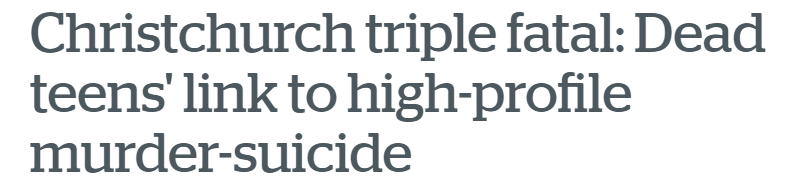
This article revealed, Glenn Mcallister the uncle of Glenn and Craig Mcallister who died in the car crash, was the gunman who shot and killed a 22 year- old then proceeding to himself in the Christchurch city centre 1989. The 22 year- old victim was later revealed to be Wayne Motz, the son of “cricketing great” Dick Motz as reported by Stuff (2019) . The New Zealand media were quick to pick up this angle and from that point onwards used the Mcallister criminal uncle to frame the news about the crash. NZ
Herald: Christchurch triple fatal: Dead teens’ link to high-profile murder-suicide
Stuff: Teen killed in crash named after uncle who shot dead NZ cricketing great’s son
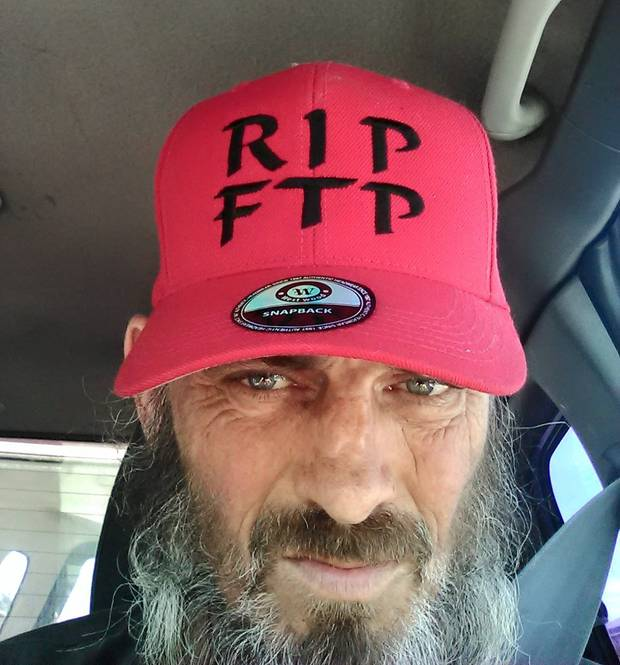
These articles also made reference to the past of the Mcallister brother’s father, Craig Mcallister. The portrayal of Craig as a grieving was distorted by the reports of him being an ex-drug addict and former skinhead. Craig spoke to the NZ Herald pleading with the public not to judge him and his family, whereby he made the accusation: “the police killed my kids… it’s not about me”. NZ Herald then reported Craig had posted a picture to his Facebook account sported a red cap embroided with the names of deceased children Glen and Craig and ‘RIP FTP’ on the front. While the New Zealand media, reported on Juanita Hickey’s Facebook tributes with headlines such as: “Grieving mother of brother killed in Christchurch police chase is in severe shock”. Whereas reports of the tributes posted by Craig Mcallister were treated with a “controversy frame” (D’Angelo, P., & Kuypers, J. A., 2010) of which Entman (1993) says “ will guide the audience members’ feelings and thoughts about the controversy in predictable ways”.
The use of the journalistic ‘controversy frame’ was clearly demonstrated by Andrew Dickens who wrote an opinion piece by Andrew Dickens titled: “To the dad of the Mcallister boys who died in the Christchurch crash: You’re wrong it’s about you”, heavily criticizing Craig Mcallister’s demeanor. Dickens was quoted to have said it was a case of the “feral bringing up the feral, trash begets trash”, he critized Craig for his dismissal of his son’s stealing crashes before their death and his “boys will be boys comments”. Dickens comments were largely popular with the public, and garnered many, shares, likes and comments. Excerpts from Dickens opinion was later quoted in articles by the NZ Herald and Newshub.
“Journalists are compelled to report the news, not create the news” (Applegate, 2007) of which The Spinoff’s, Madeline Chaplin argued, the later was demonstrated in the reporting of the Mcallister boy’s death. In an opinion piece that served as a rebuttal to the reporting of Dickens opinion piece, Chaplin spoke about the disservice New Zealand media had done by vilifying the dead teenagers because their blood relation to Glen Mcallister and to their ex-skinhead father. Chaplin, heavily criticized news sources such as the NZ Herald for their story: “Dead teen’s link to high-profile murder-suicide”, whereby she questioned whether those articles were constructed objectively, reinforcing the view perpetuated by Applegate (2007) “Reporter sometimes push their ideas in stories”. Simpson and Cote (2006) said “Reporters should avoid speculating about what caused someone’s death”. As this story developed, it became less about what happened and rather about who was to blame, firstly the public and the media placed the attention on the police, secondly Dickens had placed blame on Craig Mcallister.
The media discussion in regard to who was to blame for the crash resurfaced in early May, as the Mcallister boy’s mother Juanita Hickey spoke to RNZ, where she alleged that the DHBs negligence in refusing to provide care for her 13-year-old boy Craig Mcallister contributed to his death. In article produced by 1newsnow, Juanita spoke openly about have a premonition that her son was “going to die”. The reports done on Juanita Hickey and her perspective, contrast significantly with the articles produced comments made by the father, Craig Mcallister. In Hickey’s interviews she was depicted as a grieving mother who had grievous concerns about her sons before their death,
Craig Mcallister comments blaming the police; however, he was not depicted in the same empathetic light. Firstly, emotive language was used to describe Juanita; she was said to have “begged”, “pleaded”, “extreme fears” as written by RNZ, 1newsnow, Stuff, all of which depicted her as a person grieving for the loss of her son. Whereas the media became fixated on the Craig Mcallister’s criminal past, once that information was released that became the description of the father: “former drug addict” and “ex- skinhead”. The differences in the reporting of the demonstrated the journalist’s construction of news, framing articles glorifying the perspective of Juanita Hickey and vilifying Craig Mcallister.
References
1newsnow (2019) Christchurch mother whose teen sons died after speeding from police: ‘I had extreme fears that Craig was gonna die’
Retrieved from: https://www.tvnz.co.nz/one-news/new-zealand/christchurch-mother-whose-teen-sons-died-after-speeding-police-had-extreme-fears-craig-going-die
Applegate, E 2007, ‘The Concepts of “News Balance” and “Objectivity”, Public Relations Quarterly, vol. 52, no. 4, pp. 5-8.
D’Angelo, P., & Kuypers, J. A. (Eds.). (2010). Doing news framing analysis: Empirical and theoretical perspectives. Routledge.
Dickens, A. (2019) Dickens: NZ’s cycle of violence exposed by Chch triple fatal
Retrieved from: https://www.newstalkzb.co.nz/on-air/larry-williams-drive/opinion/andrew-dickens-christchurch-crash-another-example-of-ferals-raising-ferals/
Hamad, R. (2017). ‘Both sides’ journalism betrays the public interest. Eureka Street, 27(18), 3.
Macmanus (2019) The faces of fatal police chases: Teens make up half of the crash victims
Retrieved from: https://www.stuff.co.nz/national/109924118/the-faces-of-fatal-police-chases-teens-make-up-half-of-crash-victims
Morse, T. (2014). Covering the Dead: Death images in Israeli newspapers—ethics and praxis. Journalism Studies, 15(1), 98-113.
Newstalk ZB (2019) Andrew Dickens: To the father of the Mcallister boys killed in the Christchurch crash
Police Media Team (2019) Three die in Christchurch after fleeing Police
Retrieved from: https://www.police.govt.nz/news/release/three-die-christchurch-after-fleeing-police
Sherwood, S. (2019) ‘Forever 13 & 16’: Fatal Pursuit crash scene becomes memorial to killed teens
Retrieved from: https://www.stuff.co.nz/national/crime/109927861/forever-13–16-fatal-pursuit-crash-scene-becomes-memorial-to-killed-teens
Sherwood, S. (2019) Teen killed in crash named after uncle who shot dead NZ cricketing great’s son.
Retrieved from: https://www.stuff.co.nz/national/crime/109979270/teen-killed-in-crash-named-after-uncle-who-shot-dead-nz-cricketing-greats-son
Sherwood, S. (2019) Young brothers killed after fleeing car explodes in a ‘huge ball of fire’.
Retrieved from: https://www.stuff.co.nz/national/crime/109919195/young-brothers-killed-after-fleeing-car-explodes-in-huge-ball-of-fire
Strang, B. & Palmer, R. (2019) IPCA police pursuit report leaves policy unchanged, recommends more training and improved technology.
Retrieved from: https://www.rnz.co.nz/news/top/384777/ipca-police-pursuits-report-leaves-policy-unchanged-recommends-more-training-and-improved-technology
Sutherland, M. (2019) ‘Mum did this for you’: Teen brothers killed in killed in a Christchurch crash get burnout tribute.
Retrieved from: https://www.newshub.co.nz/home/new-zealand/2019/01/mum-did-this-for-you-teen-brothers-killed-in-christchurch-crash-get-burnout-tribute.html
Sutherland, M. (2019) Families grieve teens killed after Christchurch police pursuit
Retrieved from: https://www.newshub.co.nz/home/new-zealand/2019/01/families-grieving-the-loss-of-teens-killed-in-christchurch-abandoned-police-pursuit.html
Sutherland, M. (2019) Police stand by pursuit policy after Christchurch triple-fatal crash.
Retrieved from: https://www.newshub.co.nz/home/new-zealand/2019/01/police-stand-by-pursuit-policy-after-christchurch-triple-fatal-crash.html
Tverdek, E. (2008). What Makes Information” Public”?. Public Affairs Quarterly, 22(1), 63-77.

 Journalism blog